The newsletter of the facts
E-News
Subscribe to E-News
Our daily analytical digest breaking down the data driving modern policy and markets.

Thursday 10 September 2026 - 01:57pm

A commercial aircraft prepares to land at an airport, illustrating the role of air connectivity in Africa's aviation sector. Photo Credit: NNA News
NNA News - African aviation leaders and policymakers have called for faster implementation of the Single African Air Transport Market (SAATM), with regulatory harmonisation, greater market access and stronger cooperation identified as priorities for improving connectivity across the continent.
The call came at the 10th Aviation Africa Summit and Exhibition, which opened in Nairobi on Wednesday and runs until Thursday at the Sarit Expo Centre. The two-day event is hosted by Kenya's State Department for Aviation and Aerospace Development, Kenya Civil Aviation Authority, Kenya Airports Authority and Kenya Airways.
The summit has brought together aviation authorities, airlines, airports, policymakers, investors and other industry stakeholders from across Africa and beyond. The organisers said representatives from 103 countries, including 47 African countries, and 135 airlines and operators are participating, with about 2,500 attendees expected.
Speaking at the opening, Kenya's Prime Cabinet Secretary and Cabinet Secretary for Foreign and Diaspora Affairs Musalia Mudavadi said aviation had a wider economic role than transporting passengers. “Aviation is not just a means of transportation. It is an enabler of trade, tourism, investment, healthcare, education, humanitarian assistance and cultural exchange,” Mudavadi said. He said limited connections between African countries continued to increase travel times and costs, with some passengers required to transit through destinations outside the continent when travelling between neighbouring countries.
Mudavadi called on African states to accelerate implementation of SAATM, an African Union Agenda 2063 flagship initiative designed to establish a single unified air transport market and promote intra-African connectivity. “I urge all African States to deepen collaboration in implementing SAATM through harmonised regulations, mutual recognition of standards, strengthened safety oversight, open skies, and coordinated investment in aviation infrastructure,” he said. The African Union describes SAATM as a mechanism for improving connectivity between African capitals and supporting the continent's wider economic integration and growth agenda.
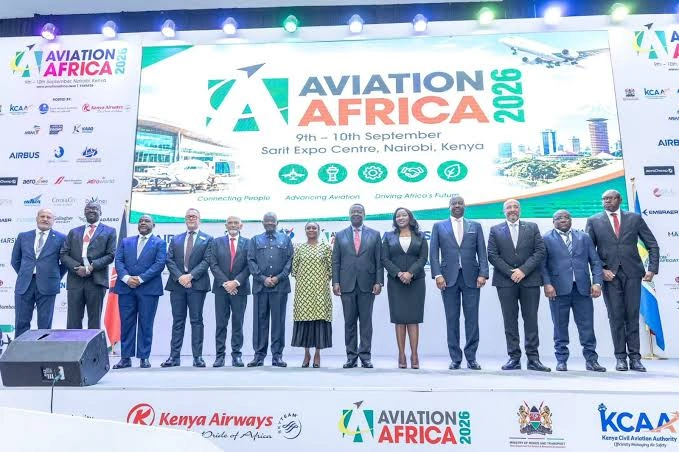
Officials pose for a group photograph during the Aviation Africa 2026 summit at the Sarit Expo Centre in Nairobi, Kenya, on 9 September 2026. Photo credit: Aviation Africa
AdeSewa Adeyemi, Secretary General of the African Civil Aviation Commission (AFCAC), said the continent's aviation integration would require action across several areas, including market access, physical connectivity, affordability and the financial sustainability of African airlines. Speaking at the Nairobi summit, Adeyemi said only about 15% of Africans can currently afford air travel and called for greater cooperation between states, airlines and airports. “Success will not be measured by how many meetings we hold; it will be measured by how many African cities are connected, how many routes open, and how many fares become more affordable,” Adeyemi said. She said AFCAC was ready to work with African states, airlines, airports and regional communities to strengthen infrastructure and expand route networks.
The comments reflect a longstanding gap between continental aviation commitments and implementation at the national level. SAATM was established as an AU flagship project to liberalise civil aviation markets and remove restrictions affecting air services between African states. The call for stronger government cooperation comes as African airlines continue to face high operating costs and regulatory and market-access challenges.
AFRAA Secretary General Abderahmane Berthé said earlier this year that the continent continued to face a gap between commitments and implementation under SAATM and the Yamoussoukro Decision. “We continue to face gaps between commitment and implementation. Liberalisation under the Yamoussoukro Decision and SAATM must be treated as an economic competitiveness strategy, not merely an aviation policy commitment,” Berthé said at an AFRAA workshop in Nairobi in February.
AFRAA said international markets remained highly competitive, with non-African airlines carrying 50.8% of international traffic involving African markets in January 2026, compared with 49.2% for African airlines. On intercontinental routes, the gap was wider, with non-African airlines carrying 67.1% of traffic. Berthé has argued that successful liberalisation requires alignment between governments and airlines, alongside transparent and predictable regulations.
At the Nairobi summit, the wider aviation agenda also includes airport infrastructure, emerging technologies, sustainability, aviation safety, affordability and the development of local skills. Mudavadi said Kenya was supporting investment in sustainable aviation fuels, energy-efficient airport infrastructure, carbon reduction initiatives and climate-resilient aviation systems, while also encouraging the use of artificial intelligence, digital air traffic management, biometrics and automation.
The push for SAATM implementation comes as African governments seek to strengthen intra-continental trade under the African Continental Free Trade Area. For the aviation sector, the Nairobi discussions highlight the continuing effort to translate continental commitments into more routes, greater competition and more affordable air travel. The summit continues in Nairobi on Thursday.

Join 46,000+ global citizens, corporate executives, and decision-makers who rely on NNA every day for definitive clarity. Enter your email to unlock uncompromised perspective for free.
No thanks, take me back to the home page.We respect your inbox. Unsubscribe in one click, any time.
Three ways to get NNA News the moment it breaks.
Our daily analytical digest breaking down the data driving modern policy and markets.
High-utility situational intelligence delivered directly to your inbox before your first meeting.
The whole network in your pocket, with breaking-news alerts.