The newsletter of the facts
E-News
Subscribe to E-News
Our daily analytical digest breaking down the data driving modern policy and markets.

Tuesday 15 September 2026 - 10:05am

Residents walk through floodwater at a makeshift settlement in Somalia as heavy rains leave parts of the community inundated. Photo: SoDMA
NNA News - Somalia is strengthening preparations for potential flooding ahead of the October to December Deyr rainy season, as climate forecasts point to increased rainfall and heightened flood risks in parts of the country.
The Somali Disaster Management Agency (SoDMA) has urged communities in 29 districts across 14 regions to prepare for potentially heavy rains associated with strengthening El Niño conditions. “The rains are expected during the Deyr season in October, November and December, with communities in vulnerable areas advised to take early precautions,” SoDMA said in a warning reported by the Somali National News Agency (SONNA).
The agency's warning comes as Somalia expands early action measures designed to reduce the impact of possible flooding along major river systems and in other vulnerable areas. SoDMA Commissioner Mahmoud Moallim Abdulle has recently visited Beledweyne in Hirshabelle State, where officials assessed flood-prone areas and the Shabelle River. The agency said the visit was intended to strengthen preparedness and prevent potential flood-related losses.
Abdulle urged communities to clear waterways and avoid areas that could be affected by flooding, while authorities were also assessing vulnerable sections of riverbanks and strengthening public awareness. The flood warning is supported by regional climate forecasts. The Food and Agriculture Organization of the United Nations said on September 1 that strengthening El Niño conditions and an unusually strong wet-season forecast were increasing the risk of significant flooding during Deyr 2026.
FAO said the latest seasonal outlook indicates a strong likelihood of wetter-than-normal conditions across much of Somalia, with the probability of above-normal seasonal rainfall reaching 90 percent in the strongest forecast zone covering large parts of central and southern Somalia. “The 90 percent probability is an exceptionally strong wet signal. It does not mean flooding is certain, but it tells us that we must use the lead time available to act before impacts occur,” said Bethwell Mutai, FAO's lead meteorologist.
The UN Office for Disaster Risk Reduction has similarly identified the Jubba and Shabelle river corridors as areas of concern if El Niño strengthens alongside a positive Indian Ocean Dipole. UNDRR said the scenario is not certain but emphasised the importance of early action, given Somalia's limited capacity to absorb additional shocks. It recommended stronger early-warning and evacuation systems, improved water, sanitation and health preparedness, and planning for potential displacement.
FAO said the Juba and Shabelle catchments are expected to experience particularly strong rainfall signals during October, with wetter conditions likely to continue into November. It also warned that river levels can remain high or continue rising because of rainfall upstream in Ethiopia, even when rainfall in Somalia temporarily eases. “We already have the strategic warning. The task now is to progressively convert that warning into increasingly specific operational information – where to pre-position, when to act, which communities are at greatest risk, and when temporary weather windows may allow humanitarian agencies to reach them,” Mutai said.
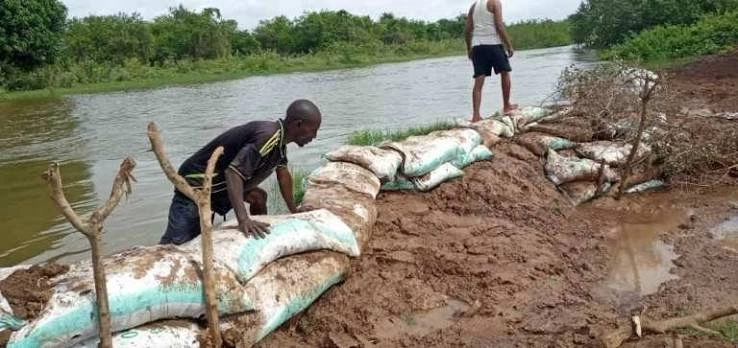
Residents reinforce a riverbank with sandbags as rising water threatens communities in Somalia. Photo: SoMDA
Somalia has been increasing its preparedness activities ahead of the rainy season. SoDMA has launched measures including medical preparedness in flood-prone areas, assessments of riverbanks and waterways, early-warning activities and coordination with humanitarian and development partners. The country has experienced severe flooding during previous El Niño events. Historical data compiled by Somalia's disaster-management authorities shows that flooding associated with the 1997-98 El Niño affected more than 900,000 people, while the 2006-07 event affected more than 440,000 people, particularly in southern and central Somalia.
The current forecast also presents an opportunity for drought-affected communities. FAO said above-normal Deyr rainfall could replenish water sources, improve soil moisture, regenerate pasture and support agricultural and livestock production, although excessive rainfall could cause destructive flooding. For Somalia's authorities and humanitarian partners, the immediate focus is therefore on converting increasingly detailed weather forecasts into practical measures, including early warnings, evacuation routes, emergency supplies and protection of vulnerable communities.
The forecast remains probabilistic rather than certain, but officials and international agencies are urging communities to use the available warning time to prepare before the Deyr rains intensify.

Join 46,000+ global citizens, corporate executives, and decision-makers who rely on NNA every day for definitive clarity. Enter your email to unlock uncompromised perspective for free.
No thanks, take me back to the home page.We respect your inbox. Unsubscribe in one click, any time.
Three ways to get NNA News the moment it breaks.
Our daily analytical digest breaking down the data driving modern policy and markets.
High-utility situational intelligence delivered directly to your inbox before your first meeting.
The whole network in your pocket, with breaking-news alerts.