The newsletter of the facts
E-News
Subscribe to E-News
Our daily analytical digest breaking down the data driving modern policy and markets.

Thursday 17 September 2026 - 01:58pm

Zimbabwean women collect agricultural supplies, including bags of grain, as part of efforts to support food security and livelihoods amid drought concerns. Photo: Reuters
NNA News - Zimbabwe will expand food imports and strengthen its strategic grain reserves as the government prepares for below-normal rainfall and a projected sharp decline in cereal production during the 2026/2027 agricultural season.
Information, Publicity and Broadcasting Services Minister Zhemu Soda said Cabinet had approved a six-pillar drought mitigation plan after the country's latest seasonal outlook pointed to a difficult rainfall season. The plan includes enhanced grain reserves, climate-smart production, agricultural financing, livestock drought measures, food imports, and stronger early-warning systems.
“With the six strategic interventions, the national total cereal production expected for the 2026-2027 season is 1,6 million tonnes,” Soda said in the post-Cabinet briefing. The government expects a cereal deficit of between 266,881 and 541,881 tonnes and will allow private companies to import grain for human consumption and livestock feed, while households will continue to import basic food items.
The projected output would represent a substantial decline from the 2025/26 season, when Zimbabwe's official second-round agricultural assessment put total cereal production at about 2.74 million tonnes. The assessment also projected a national cereal surplus for the 2026/27 marketing year under different consumption scenarios.
The new forecast reflects a significant change in the country's production outlook. Zimbabwe's Meteorological Services Department says El Niño is expected to persist through the 2026/27 season, while a positive Indian Ocean Dipole is forecast to remain in place until early 2027. The combination increases the likelihood of below-normal rainfall.
Environment, Climate and Wildlife Minister Evelyn Ndlovu said the seasonal forecast should be used to support early planning rather than waiting for the effects of drought to emerge. “This seasonal climate statement is a critical national planning tool,” Ndlovu said, urging government, businesses and communities to prepare before weather hazards develop into disasters.
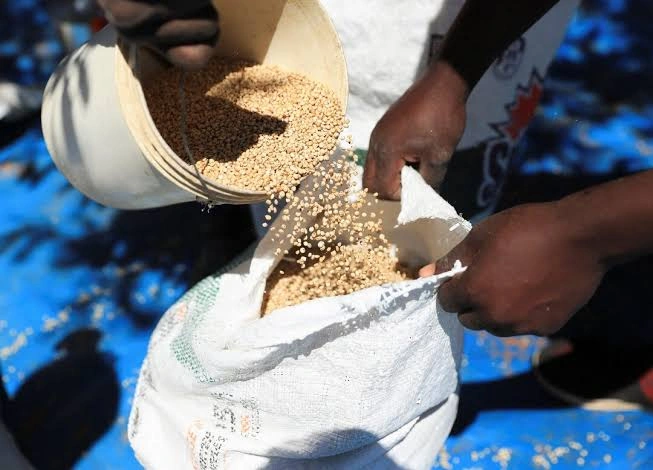
Grain is poured into a sack during the distribution of agricultural supplies in Zimbabwe, highlighting efforts to support farmers and strengthen food security. Photo: Reuters.
Agriculture Minister Anxious Jongwe Masuka said the government's immediate priorities included increasing grain reserves and expanding climate-smart farming. He said the measures would operate at both household and national levels, including support for the Pfumvudza/Intwasa conservation agriculture programme. “The most important are building the strategic grain reserve and accelerating or enhancing climate-smart practices,” Masuka said.
The regional outlook is also pointing towards a difficult season. SADC's August climate outlook forecasts below-normal rainfall across much of central and southern Southern Africa, including Zimbabwe, during October to December 2026.
FAO has urged governments to turn seasonal forecasts into practical measures for farmers. Patrice Talla, FAO Subregional Coordinator for Southern Africa and Representative in Zimbabwe, said forecasts need to be translated into decisions on crops, planting and livestock. “A rainfall forecast only protects livelihoods once it is downscaled to the district and the livelihood zone,” Talla said.
FAO and WFP have separately called for anticipatory action ahead of the strengthening El Niño, including drought-tolerant seeds, livestock protection, water management, agricultural advice and early-warning measures. The government is now preparing for a season in which lower rainfall, higher temperatures and elevated fuel and fertiliser costs could place additional pressure on agricultural production and food supplies.

Join 46,000+ global citizens, corporate executives, and decision-makers who rely on NNA every day for definitive clarity. Enter your email to unlock uncompromised perspective for free.
No thanks, take me back to the home page.We respect your inbox. Unsubscribe in one click, any time.
Three ways to get NNA News the moment it breaks.
Our daily analytical digest breaking down the data driving modern policy and markets.
High-utility situational intelligence delivered directly to your inbox before your first meeting.
The whole network in your pocket, with breaking-news alerts.