 English
 Français
 Português
 Español
 العربية
The newsletter of the facts
E-News
Subscribe to E-News
Our daily analytical digest breaking down the data driving modern policy and markets.

Monday 31 August 2026 - 10:25am

Officials conduct a marine fish mortality investigation at a coastal site in this illustrative image. Photo: Cape Town News
NNA News - South African authorities are investigating new reports of sardine deaths along the country's coast after fresh strandings were reported in the Eastern and Western Cape.
The Department of Forestry, Fisheries and the Environment (DFFE) said Sunday that isolated sightings had been recorded at Bakoven and off Tsitsikamma, while larger numbers of sardines were reported washing ashore around Gqeberha on Aug. 27. Dead fish were also seen floating offshore and inside the harbour. The latest reports come after DFFE said on Aug. 23 that no new mass-mortality incidents had been recorded since Aug. 16, suggesting that the acute phase of the event may have eased. DFFE said the new incidents are now being investigated to establish whether they are connected to the earlier mortality event along the Western Cape.
The department said pilchard herpesvirus (PHV) remains the leading explanation for the Western Cape deaths. However, it cautioned that the link between the Western Cape and Gqeberha incidents still requires confirmation and that other possible causes, including environmental factors, will also be examined. "PHV remains the leading explanation for the Western Cape mortality event. A link with the Gqeberha event is considered likely, but requires confirmation, and other causes and environmental contributions will also be investigated," DFFE said.
Earlier laboratory work confirmed the presence of PHV genetic material in sampled sardines. However, DFFE has stressed that the presence of the virus alone may not fully explain the mortality, as it was also detected at lower levels in some apparently healthy fish. Scientists are therefore continuing to investigate possible environmental stressors. The investigation has also extended beyond South Africa. Sardine strandings have been reported along the Namibian coast, with Namibian authorities agreeing to provide samples for testing.
DFFE said samples are being collected for further laboratory analysis, while observers will document the distribution of affected fish and conduct systematic counts at sea. The incident has also affected operations at Koeberg Nuclear Power Station north of Cape Town, where live and dead sardines were reported in the cooling-water intake basin.
Eskom said Unit 1's generation was temporarily reduced in August because of seawater intake challenges associated with a sardine influx near the station's cooling-water system. The unit was subsequently taken offline following a turbine trip on Thursday. Eskom said nuclear safety was not compromised and there was no risk to employees, the public or the environment. An intergovernmental task team met on Aug. 26 and assigned responsibilities covering surveillance, testing, disposal of dead fish, public communication and assessment of the impact on sardine stocks.
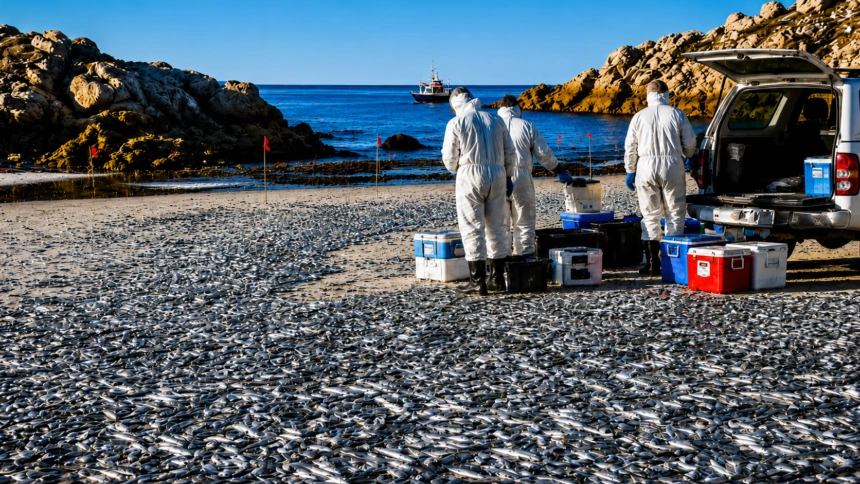
Officials conduct a marine fish mortality investigation at a coastal site in this illustrative image. Photo: Cape Town News
DFFE's Small Pelagic Scientific Working Group is expected to meet on Sept. 4 to review the latest findings and advise on possible fisheries management measures. The department said the full scale of the mortality remains uncertain, with the October/November hydroacoustic survey expected to provide important information on the condition of the sardine population.
DFFE has again urged members of the public not to collect, eat or feed dead or dying sardines to pets because of risks associated with decomposing fish. The department said investigations and monitoring would continue as further test results become available.

Join 46,000+ global citizens, corporate executives, and decision-makers who rely on NNA every day for definitive clarity. Enter your email to unlock uncompromised perspective for free.
No thanks, take me back to the home page.We respect your inbox. Unsubscribe in one click, any time.
Three ways to get NNA News the moment it breaks.
Our daily analytical digest breaking down the data driving modern policy and markets.
High-utility situational intelligence delivered directly to your inbox before your first meeting.
The whole network in your pocket, with breaking-news alerts.