
Brazil marks World Refugee Day as refugee numbers rise amid global displacement crisis
Tuesday 23 June 2026 - 09:40pm
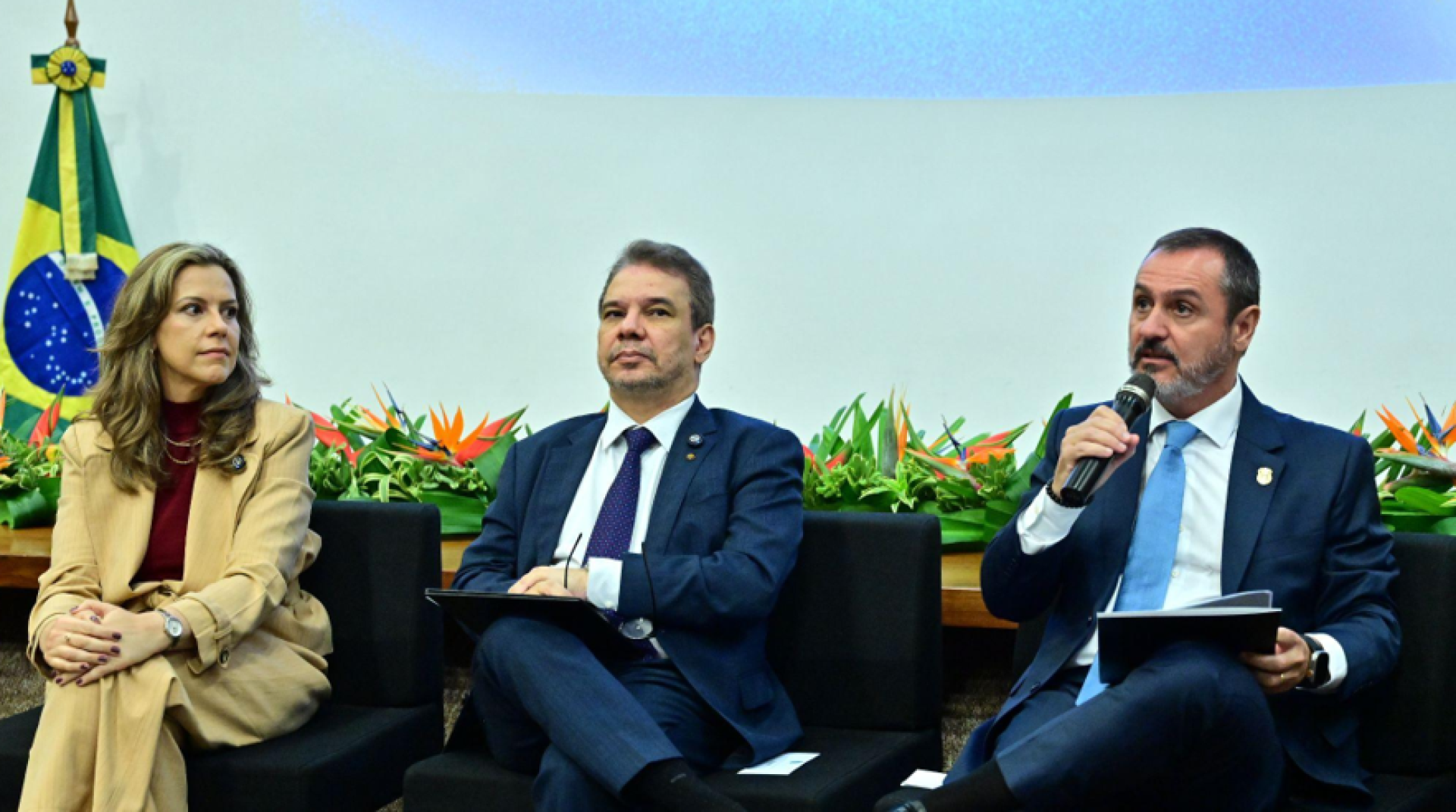
Ceremony at the Ministry of Justice and Public Security in celebration of the Convention relating to the Status of Refugees, which turns 75 years old, within the framework of World Refugee Day 2026, on June 22, 2026. Photo: Isaac Amorim/MJSP
NNA News – Brazil marked World Refugee Day on Monday with a ceremony at the Ministry of Justice and Public Security in Brasília, celebrating the 75th anniversary of the Convention Relating to the Status of Refugees. According to Brasil 247, the event brought together representatives from the federal government, the justice system, international organizations and civil society to discuss refugee protection, integration and current global challenges.
The ceremony also featured Sister Rosita Milesi, a longtime refugee rights advocate, and Iranian refugee singer Mah Mooni, who performed during the event. Throughout the discussions, officials and experts argued that refugee policy has become increasingly relevant as a social assistance policy. Participants highlighted Brazil’s progress in refugee protection, identification and reception while acknowledging persistent challenges, including isolated cases involving refugees held at major Brazilian airports.
Speakers also stressed the need to combine protection policies with economic integration strategies. They noted that, in a context of a strong economy and near-full employment, Brazil must also discuss labor migration policies. Participants emphasized that many refugees already contribute to employment and income generation in the country.
They further argued that integration is a long and complex process that requires initial reception, Portuguese-language courses and inclusion in local communities. Economic integration becomes essential afterward, requiring stronger coordination among existing initiatives through a structured national policy.
Participants noted that Brazil occupies a strategic position internationally because it is geographically distant from the world’s main armed conflicts. At the same time, they warned against reducing migration debates solely to economic considerations, emphasizing that refugees contribute in broader ways. Opening the event, National Justice Secretary Maria Rosa Guimarães Loula said that “refugee protection is also an asset that countries can benefit from.”
Representing the United Nations High Commissioner for Refugees (UNHCR), Davide Torzilli stated that “seeking asylum is a human right.” He said global crises have become more complex because of their intersection with climate challenges and noted that Brazil has been strengthening its national protection system.
Deputy Prosecutor General André de Carvalho Ramos said the anniversary marks 75 years of the Refugee Convention, which evolved from having temporal and geographic limitations into what he described as a “major achievement for human rights.” He added that Brazil is among the countries most committed to pursuing this “ideal of dignity.”
Marcia Loureiro, executive secretary for Brazilian Communities and Consular and Legal Affairs at the Foreign Ministry, highlighted the role of local communities in refugee reception. She said that, amid worsening international humanitarian crises, it is increasingly necessary to “reaffirm the principle of solidarity” and recognize refugees’ contributions to the country. Isadora Lacava, deputy executive secretary at the Ministry of Human Rights and Citizenship, highlighted the National Forum of Migrant, Refugee and Stateless Leaders (FOMIGRA) as an innovation in the field.
Federal Police Director-General Andrei Rodrigues said that “technical rigor, efficiency and respect for human dignity must guide the Federal Police in this area.” He noted that the institution is responsible for receiving applications, identifying refugees and ensuring the security of the system.
Justice and Public Security Minister Wéllington César Lima e Silva described the National Committee for Refugees (Conare) as a “central structure of Brazil’s refugee policy,” bringing together government institutions, civil society and UNHCR. He said Brazil holds a “leading position” in the area and reaffirmed the government’s commitment to multilateralism. During the event, UNHCR and the International Migration Observatory (OBMigra) launched the reports “Global Trends: Forced Displacement in 2025” and “Refuge in Numbers 2026.”
According to the UNHCR report, there are currently 117.8 million forcibly displaced people worldwide. Of these, 41.6 million are refugees and 9 million are asylum seekers. The report states that seven out of ten refugees originate from just five countries: Afghanistan, South Sudan, Syria, Ukraine and Venezuela. Children account for 39 percent of the global refugee population.
In the Americas, the world’s main region for hosting forcibly displaced people, there are 9.9 million internally displaced persons. The region registered 23 million forcibly displaced people in 2025, compared with 22 million in 2024. The report also states that Brazil received 75,600 new asylum applications in 2025, an increase of 11 percent compared with the previous year.
The “Refuge in Numbers 2026” report shows that 165,774 refugees were officially recognized in Brazil in 2025, representing growth of 5.9 percent compared with 2024. During the same period, 75,559 immigrants applied for refugee status. Authorities processed 50,568 applications, and 9,162 individuals were recognized as refugees.
The study found that Cuba surpassed Venezuela as the leading country of origin for new asylum requests in 2025, accounting for 55.4 percent of applications. Venezuela followed with 28.1 percent, while Colombia, Angola and Morocco each accounted for less than 1.9 percent. Among recognized refugees in 2025, Venezuelans represented 89.8 percent and Afghans 1.1 percent. According to the report, 52.4 percent of refugee application assessments were concentrated in Brazil’s Northern Region, particularly in the states of Roraima and Amapá.
The report also recorded an increase in the participation of Afghans in Brazil’s labor market. In 2025, 1,209 Afghan workers were formally employed, compared with 995 the previous year. Among the challenges identified, the study found that 82.9 percent of Brazilian municipalities do not have initiatives aimed at combating xenophobia. In addition, only 14.3 percent offer public services in multiple languages.
In the Municipal Institutional Capacity Index for Migration Policies, São Paulo was the only municipality classified as having “very high institutional capacity.” Goiânia, Belo Horizonte, Jundiaí and Americana were classified as having “high institutional capacity.” Following the ceremony, officials spoke to the press. Maria Rosa Guimarães Loula said that “the Convention becomes more relevant every day” and stressed that Brazil’s actions have become an international reference in good practices. She also emphasized that “refugee protection cannot be confused with migration.”
Asked about prolonged detentions of migrants at Brazilian airports and reports involving Palestinians, she said that Brazil faced a large influx of migrants through Guarulhos Airport and that operational capacity in 2023 “did not respond adequately” during a specific episode. According to her, “today we have a much more structured policy.”
She added: “We do not want, under any circumstances, to become accomplices of criminals who exploit and victimize people seeking refuge, and the Federal Police has been fundamental.” Davide Torzilli said that “the scale of global displacement is unacceptable and reflects the international community’s inability to resolve conflicts and wars, thereby reducing forced displacement.”
He added that “people need not only protection, but also integration, and in this regard Brazil has demonstrated how to preserve and strengthen public policies.” Iranian singer Mah Mooni shared her experience as a refugee in Brazil. “I left Iran and came to Brazil in 2012 seeking freedom because of the lack of rights for women. Unfortunately, the Islamic regime in Iran does not allow women to live a normal life. That is why I left Iran. I am a singer, but singing as a woman in Iran is prohibited. You cannot go on stage and sing because you are a woman,” she said.
She also expressed support for popular protests that took place in Iran before the war involving the Iranian government. “There was a major massacre in Iran in June, when the Islamic regime killed protesters who were demanding basic rights in the streets,” she said. Mah Mooni added: “Iran is not anti-imperialist. They are allies, but when a government kills its own people, you cannot remain neutral.”
Regarding the political situation in Iran and the war involving the country, she stated: “With the death of Ali Khamenei at the beginning of the war, the military gained more power and the government became even more violent.”She also spoke about her relationship with Brazil: “Now I am an Iranian and Brazilian woman. During the World Cup, my team is Brazil. I love Brazil and the affection of Brazilians.”
She concluded with an appeal to Brazilian authorities: “I wish all people knew Brazil’s power, but when Brazil remains neutral in the face of human rights violations, that is harmful.” She added, “I am happy that I chose Brazil as the place to live.”