
Brazil unveils progress on ecological transition plan
Friday 03 July 2026 - 07:41pm
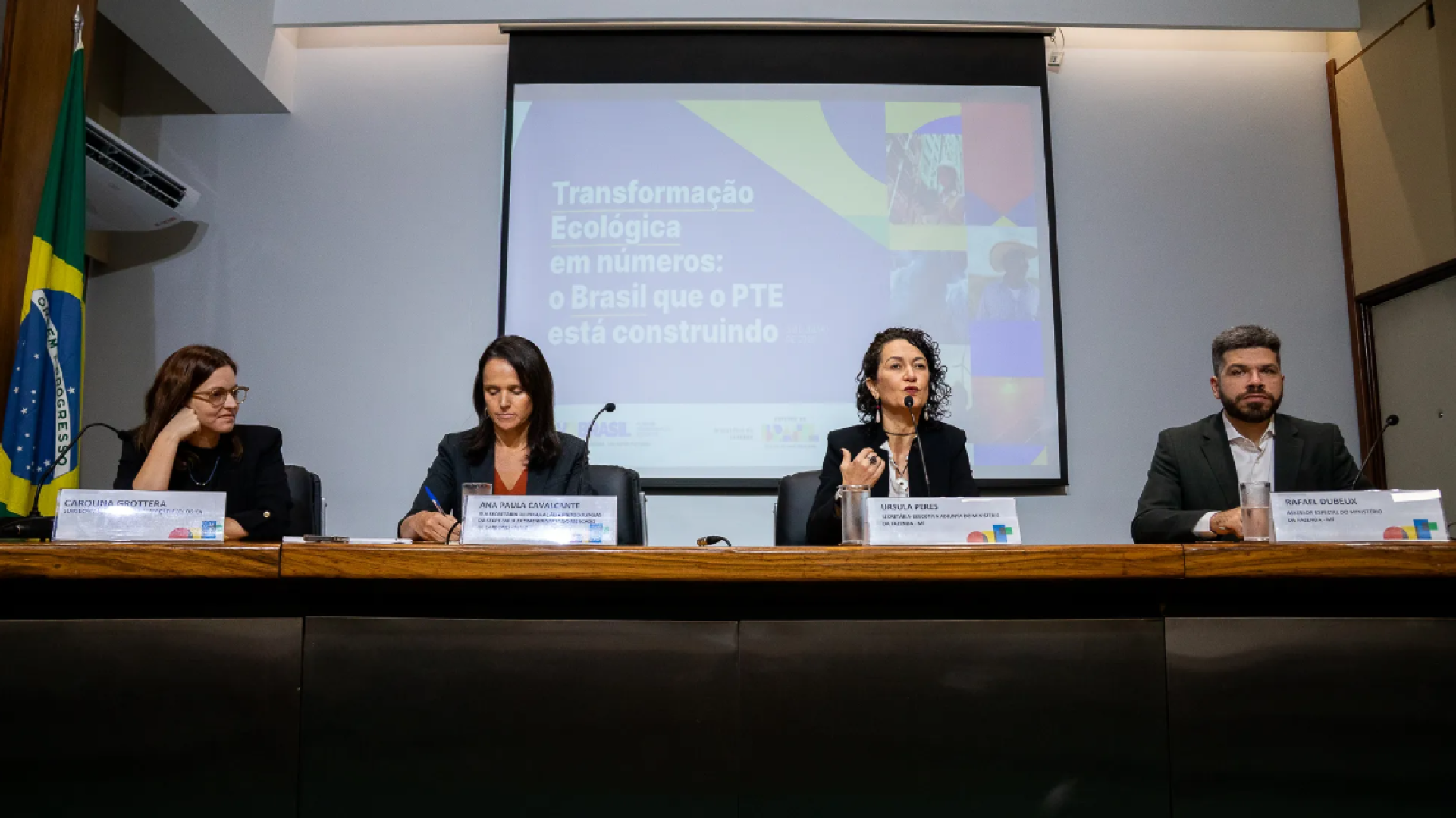
Presentation of data on the Ecological Transition Plan (ETP) at the Ministry of Finance.Credit: Washington Costa/MF
NNA News – Brazil's Ministry of Finance on Friday presented new data on its Ecological Transition Plan (PTE), describing it as the foundation for a new development model that combines economic growth with environmental sustainability and social inclusion. The information was originally reported by Brasil 247, based on a press conference held by the ministry and information from Sputnik Brasil.
Senior officials from the Ministry of Finance outlined the progress of the plan during the event "Ecological Transformation in Numbers: The Brazil that the Ecological Transition Plan is Building." Participants included Ecological Transformation Secretary Carolina Grottera, Carbon Market Regulation and Methodologies Secretary Ana Paula Cavalcante, Deputy Executive Secretary Ursula Peres and Special Adviser Rafael Dubeux.
Ursula Peres linked Brazil's energy strategy to the current geopolitical environment. She said conflicts such as those in Ukraine and Iran have exposed the vulnerability of countries that rely heavily on fossil fuels, while Brazil benefits from the diversity of its energy matrix. According to Peres, the Ecological Transition Plan, launched in 2023, was designed as a cross-government initiative that combines economic growth with environmental and social sustainability. She added that the plan aims to attract investment, expand foreign funding, strengthen the Climate Fund, increase research investment and provide greater legal certainty, citing sovereign bond issuances in yuan and euros.
According to the ministry, Brazil has raised US$5.5 billion between 2023 and 2025 through Treasury bond issuances dedicated to strategic sectors of the ecological transition. During the same period, the Climate Fund expanded its available resources by 316 times, reaching R$27 billion. The main financed sectors include energy transition, green industry, green logistics and mobility, machinery and equipment, and the conservation of forests and water resources.
Additional financing mechanisms have also been created through sectoral funds managed by the National Electric Energy Agency (Aneel) and the National Agency of Petroleum, Natural Gas and Biofuels (ANP), including an ANP carbon capture fund. In 2025 alone, R$30.7 billion was committed to technological projects, while regional development banks joined the National Development Bank (BNDES) in issuing credit instruments to support ecological transition projects.
Rafael Dubeux said the Ministry of Finance has expanded its traditional fiscal role by actively participating in the country's development strategy. He said the agenda has been embraced by the federal government as a whole, with the Ministry of the Environment serving as a key partner alongside other ministries.
Dubeux said redesigning Brazil's economic model requires time and structural changes. He argued that the country's historical growth relied on environmental degradation, unequal social relations, low productivity and limited value creation. According to him, the government is working to establish a new pattern of economic growth, with large-scale projects already underway across Brazil.
Carolina Grottera said the Ecological Transition Plan establishes solid foundations for a new development model. She noted that significant progress has been made in the carbon market, although additional work remains and implementation is scheduled through 2032. She also said the process is helping create a culture of ecological transformation within the public administration.
The ministry reported that fiscal and regulatory incentives have expanded to support strategic sectors. Issuance of debentures linked to Ecological Transition Plan projects increased by 180 percent between 2023 and May 2026. The Selective Tax established under Brazil's tax reform will incorporate negative environmental externalities while providing incentives for strategic sectors covered by the plan.
Officials also announced the pilot implementation of a sustainable taxonomy designed to classify sustainable economic activities and attract investors, including those interested in the carbon market. Seventeen economic sectors have already been incorporated into the carbon market framework in stages, including pulp and paper, iron and steel, cement, primary aluminum, mining, electricity, sanitation, and road, waterway and railway transportation.
The government expects to formally establish the Low-Emission Hydrogen Development Program (PHBC) within the coming week. The program will distinguish low-emission hydrogen from high-emission hydrogen, with planned auctions designed to cover the cost difference while prioritizing projects requiring lower fiscal incentives.
Strategic minerals also form part of the ecological transition agenda. The government highlighted mineral transformation debentures, EcoInvest auctions and a joint investment fund created by BNDES and Vale that could reach R$1 billion. A bill currently under consideration in Congress would establish both a guarantee fund and a research and development fund for the sector. Projects involving critical minerals and Sustainable Aviation Fuel (SAF) were also identified as priorities.
The ministry said financing for sustainable agriculture has increased significantly through Brazil's Plano Safra. Credit under the Corporate Plano Safra program and the National Program for Strengthening Family Agriculture (Pronaf) more than doubled between the 2021-2022 and 2025-2026 periods.
Officials also emphasized preparations for a stronger El Niño event expected later this year. Climate resilience funding directed to states and municipalities has resulted in a 1,400 percent increase in investments for slope stabilization compared with the 2019-2022 period, reaching R$13.9 billion. Additional resources from the National Environment Fund and a provisional measure allocating more than R$330 million for wildfire prevention and response are also intended to strengthen climate resilience.
The Ministry of Finance also clarified that the recent decline in sustainable bond issuance is unrelated to demand from the Climate Fund. According to the ministry, annual funding between R$1 billion and R$3 billion remains an adequate level for the program.