
Mercosur marks 35 years with trade reforms and global partnerships at Asunción summit
Monday 29 June 2026 - 05:22pm
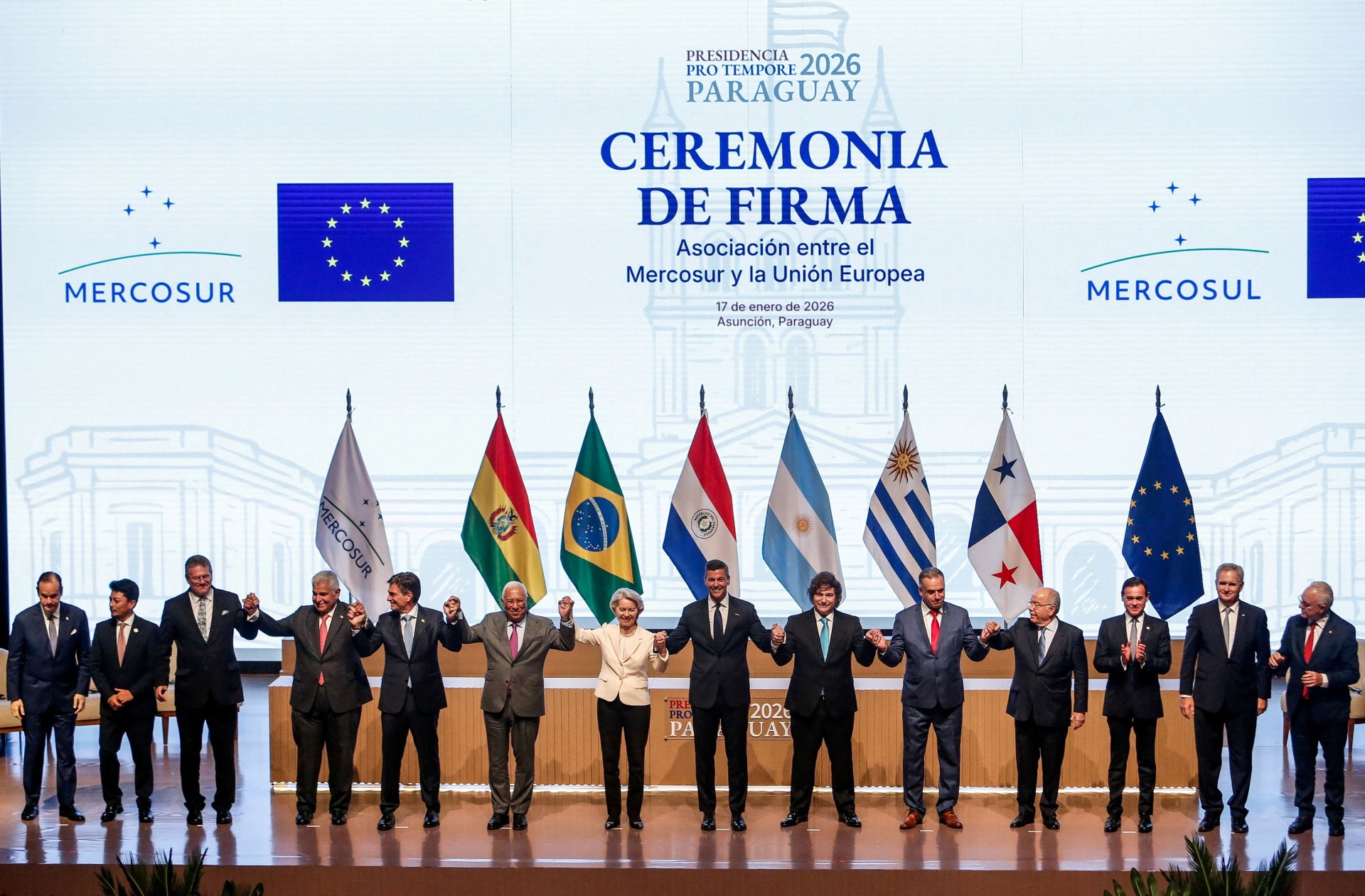
Authorities of the European Union and the South American bloc Mercosur pose during the signing ceremony of a free trade agreement, ending more than 25 years of negotiations, in Asunción, Paraguay, January 17, 2026. REUTERS/Cesar Olmedo TPX IMAGES OF THE DAY
NNA News – The 68th Mercosur Summit began on Monday (29) in Asunción, Paraguay, marking the 35th anniversary of the Treaty of Asunción that created the bloc in 1991. The opening ministerial meeting of the Common Market Council (CMC) was chaired by Paraguayan Foreign Minister Rubén Ramírez Lezcano amid a broad agenda of technical progress and preparation for the meeting of heads of state. The information was reported by Brasil 247.
At the opening, the Paraguayan chancellor emphasized the gradual nature of the integration process, stating: “We are achieving positive results that translate into benefits for the countries and their citizens.” He also noted that during Paraguay’s pro tempore presidency, more than 360 meetings were held across different institutional levels of Mercosur, ensuring continuity in the bloc’s agenda across trade facilitation, infrastructure, digital agenda, and strengthening of border control mechanisms.
According to the chancellor, meetings of the Mercosur Trade Commission (CCM) and the Common Market Group (GMC) held in Asunción in recent days consolidated progress in updating rules of origin, strengthening integrated border control areas, and advancing competition and consumer protection measures. The CCM approved 22 directives aimed at facilitating trade and modernizing the customs union, while the GMC advanced discussions on the common external tariff, sustainable development, incorporation of the automotive sector, and the digital agenda. An agreement on mutual recognition of electronic identification and authentication was also concluded, seen as a key step toward digital integration.
Seven heads of state confirmed their attendance: the five leaders of Mercosur member states, plus Chilean President José Antonio Kast and Ecuadorian President Daniel Noboa. Foreign ministers from associated states, including Colombia, Chile, and Panama, are also present. Special guests include the Minister of State for Foreign Trade of the United Arab Emirates, the Foreign Minister of Trinidad and Tobago, the Federal Foreign Minister of Germany, and the First Vice President of the Senate of Uzbekistan.
The Paraguayan chancellor also stated that the summit will include business delegations from Germany, the United Arab Emirates, and Chile, bringing more than 30 entrepreneurs interested in trade and investment opportunities in Paraguay, described as “a clear sign of the interest that Paraguay is generating in different parts of the world.”
On economic integration, discussions continue on the possible inclusion of the automotive and sugar sectors into the customs union, as well as the reduction of certain barriers to intra-bloc trade. Mercosur is also advancing the modernization of border management through minimum standards, system interoperability, and risk management in integrated control areas.
Another central point of the summit is the Mercosur Structural Convergence Fund (FOCEM), which finances infrastructure and regional inequality reduction projects. According to Brazil’s Foreign Ministry, Brazil is expected to announce an increase in its contribution to the fund’s new phase, which has already financed thousands of kilometers of roads and railways, sanitation networks, energy infrastructure, housing, and social projects across the region. New projects focused on border regions and local development are also expected to be approved in Asunción.
The bloc’s external agenda reinforces its strategy of diversifying partnerships, with ongoing negotiations involving countries such as Canada, Japan, Vietnam, India, the United Kingdom, the United Arab Emirates, and several nations in Latin America and the Caribbean.